Profit Margin Analysis
Summary
Gross Profit funds investments and operations to ultimately drive business growth. Looking only at the top-line revenue impact of a customer can lead to the wrong conclusion about who your most valuable customers are and hide the erosion of profit margins. A Sales Only customer may appear to generate the most value with higher lifetime value driven by high Transaction Frequency and high Average Order Value compared to customers with a more balanced basket composition of sales and full-priced items. When margins are considered, even if a lifetime value of a Sales Only customer, with a 15% Margin, is +25% higher than a Mostly Sales customer, the Mostly Sales customer with a 35% profit margin would be, in actuality, worth +70% more in Marginal Lifetime Value.
With 3.48M in total Active Customers, a 5% conversion of just the next purchase from Sales Only to Mostly Sales customers’ purchasing profile, the retailer could generate $1.7M in incremental Gross Profit. If 5% of Sales Only customers were to have been Mostly Sales instead, they could generate $7.4M in additional Gross Profit over their lifetime.
Targeted/Personalized marketing messaging, creation of holdout groups, omnichannel purchasing, and product breadth are some of the strategies to reduce discounting and promote full-price purchasing.
Analysis
A multi-national fashion retailer was looking to grow their business. Historically, the client focused on top-line revenue growth, driven primarily by driving spend through promotions and discounting for all clients. However, with increased competition and additional economic headwind, they were faced with slowing growth. I was asked to help analyze customer behavior and develop opportunities for sustained growth.
As the client had a long-term strategy of offering discounts to all customers and hosting promotional sales throughout the year, I sought to explore different growth strategies that would improve their gross profit. At the end of the day, gross profit is what ultimately provides resources to operate the business.
Gross Profit = Revenue - Cost of Goods Sold
Margin % = (Revenue - Cost of Goods Sold)/Revenue
The active customers (i.e. customers who made at least one purchase in the last 365 days) were categorized into 6 groups.
Sales Only - Customers who have only purchased discounted products.
Mostly Sales - Customers who not only purchased discounted products but had at least 75% of their basket being discounted products.
Likely Sales - Customers who had 75% or less but more than 50% of their basket being discounted products.
Balanced - Customers who had 50% or less but more than 25% of their basket being discounted products.
Less Sales - Customers who had 25% or less but more than no discounted products.
Full Price Only - Customers who only purchased full-priced products.

Due to the client’s historical focus on sales, 42% of all active customers (1.5M Active Customers) were Sales Only, followed by 27% of all active customers (919K Active Customers) were Mostly Sales. Therefore, strategies surrounding Sales Only customers would potentially have the most impact.

If simply looking at the number of customers and their perspective Life Time Value (LTV), it would have been correctly assumed that Sales Only customers were the most valuable. They both represent the largest portion of clients but also the most revenue generated per customer. Easily +25% higher LTV than the next highest being Mostly Sales customers and 5x the LTV of Full Price Only customers.

Breaking LTV into its respective components of Average Order Value (AOV) and Purchase Frequency allows a more granular analysis of what is driving the higher LTV of a Sales Only customers. Sales Only customers’ LTV is primarily driven by their high purchase frequency of 8, while on the other hand, Less Sales customers have the highest AOV of $175 but a much lower purchase frequency of 2. Mostly Sales customers have a balance between AOV and Purchase Frequency; being the second highest in both.
Life Time Value = Average Order Value x Purchase Frequency

AOV can be further broken into Average Unit Revenue (AUR) and Units Per Transaction (UPT).
Average Order Value = Average Unit Revenue x Units Per Transaction
Sales Only customers’ value continues to be driven by UPT while its AUR is exceedingly low. Indicating that Sales Only customers are HIGH VOLUME customers. While Full Price Only and Less Sales customers purchase higher-priced products, they are extremely low-volume, often purchasing only 1 item per transaction.

Sales Only customers’ high LTV only holds true when looking solely at Top Line Revenue without taking into account the margin squeeze due to price reduction.
Margin % = (Revenue - Cost of Goods Sold)/Revenue
Marginal LTV = Life Time Value x Margin %
Marginal AOV = Average Order Value x Margin %
Assuming COGS is consistent with the items sold (ie. fixed cost), every dollar discounted would reduce the Profit Margin of the items sold.
Initially, the LTV and AOV of the Sales Only customers was +25% and +33% higher, respectively, compared tp Mostly Sales customers. When the profit margins of 15% for Sales Only and 31% for Mostly Sales were taken into account, Mostly Sales customers were actually worth +70% more in Marginal LTV and 2.2x in Marginal AOV.
Scenario 1: Impact of Converting Sales Only Customers to Mostly Sales Customers for 1 Additional Order
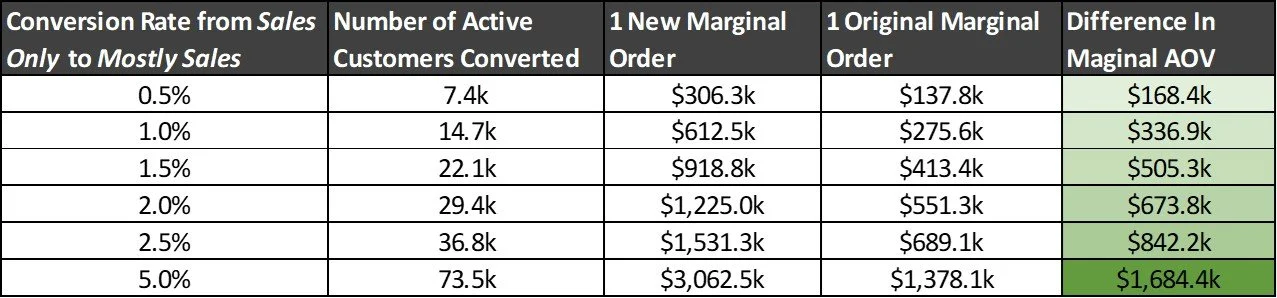
Looking at the conservative impact of converting a percentage of just the next purchase, a percentage of low margin Sales Only customers to Mostly Sales customers, could generate $337K in Gross Profit at 1% conversion and $1.7M in incremental Gross Profit at 5% conversion.
Scenario 2: Impact of Converting Sales Only Customers to Mostly Sales Customers on LTV
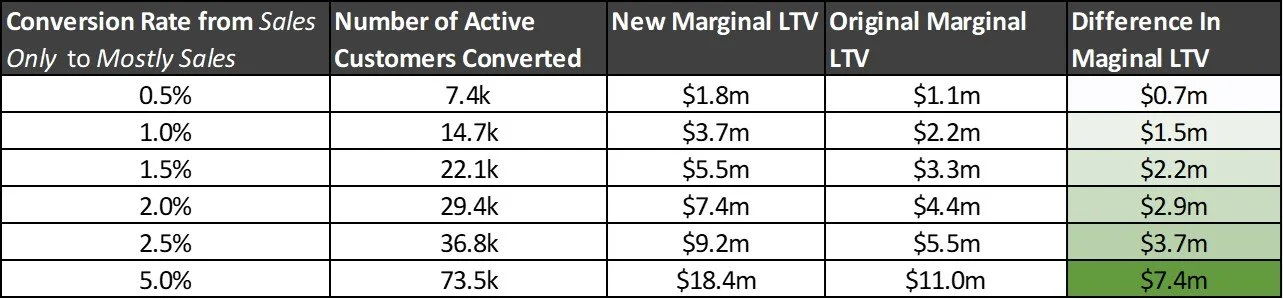
The impact is even more pronounced at the Marginal LTV level. A 1% conversion would generate $1.5M in additional Gross Profit over the lifetime of a Mostly Sales customer when compared to a Sales Only customer. A 5% conversion would generate $7.4M in additional Gross Profit over the lifetime of a Mostly Sales customer when compared to a Sales Only customer.
Conclusion
A more balanced Mostly Sales customer is actually the most valuable customer profile in terms of the Gross Profit generated per order and over the course of their lifetime. Focusing solely on top-line revenue would have concluded that Sales Only customers were the most valuable instead and caused the retail client to execute strategies that would damage their profit margin and erode future growth. Although Sales Only customers may not be the most valuable in terms of Marginal LTV and Marginal AOV, they can still be leveraged strategically to move volumes of products, such as in the case of clearing out inventory, as they have high purchase frequency and UPT. Therefore, a clear understanding of different customer behaviors and financial understanding around margins can help a company clarify how to leverage and market to different customers.
Marketing and Sales Strategy
Every type of customers have their inherent value and should be leveraged strategically. To ensure the proper behaviors are incentivized, different marketing and sales strategies could be implemented, such as:
Targeted Sales Campaigns/Marketing Holdout Groups - Promotions and marketing messages should be highly targeted. Only deliver discounts to customers who require it to incentivize full price purchasing. Inversely, reduce full price marketing content to clients who only participate in deep discounting to reduce cost.
Personalized Messaging - Content of the marketing message and product recomendation should be highly personalized to incentivize spending with the reduced need for discounting as a motivation.
Omnichannel Sales - Customers who purchase in-store have been shown to have a greater number of full-price purchasing behaviors. Create marketing messages to bring customers to stores, such as by highlighting the locations of nearest stores.
Pickup In Stores - Free pickup of online orders in stores can also increase foot traffic.
In Stores Events - Can also drive traffic to stores
Limited Edition Products (Scarcity) - Items that have inherent scarcity, whether that be through reduced inventory or through purchase time frame, can drive customers to purchase the item at full price.
Product Breadth (Value and Price) - A breadth of product types at different prices also allows customers to purchase lower-priced products without the need for discounts.
Disclaimer: Data is solely representative of the client’s scenario. Names and data have been altered for data integrity and privacy.